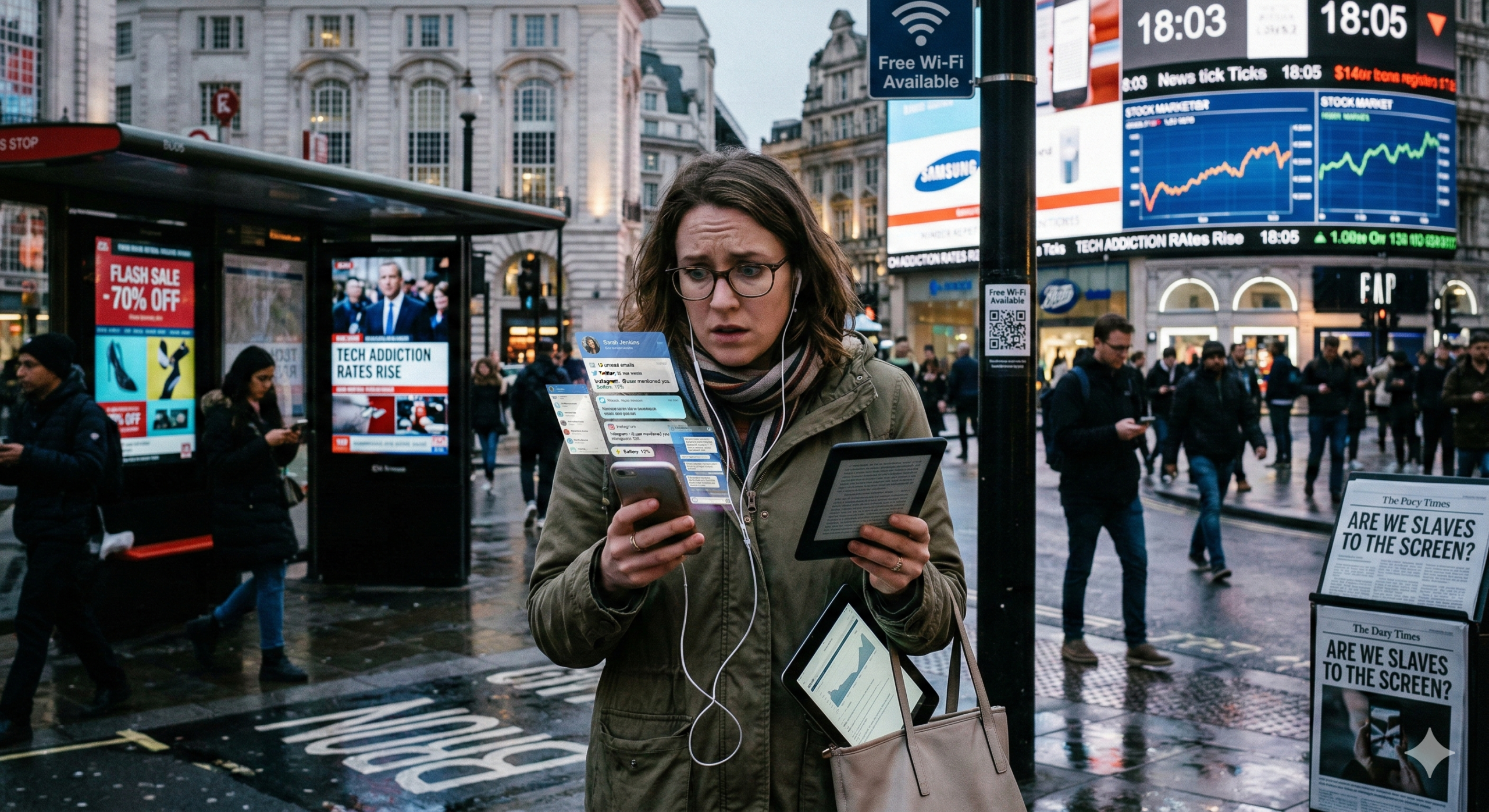
Examining how artificial intelligence, immersive experiences, omnichannel ecosystems, and the privacy paradox are fundamentally reshaping the relationship between brands and modern consumers.
Abstract
The marketing technology landscape is undergoing its most profound structural transformation in a generation. Driven by the mainstreaming of artificial intelligence, the maturation of immersive media, a radical shift in consumer privacy expectations, and the entrenchment of omnichannel commerce, brands and consumers alike are navigating unprecedented change. This study synthesises recent empirical research, industry surveys, and market data (2024–2026) to assess how consumers are adapting or resisting the wave of emerging marketing technologies, and what strategic implications this holds for practitioners.
The Scale and Speed of the MarTech Transformation
The global marketing technology market does not merely represent rapid growth — it represents a fundamental restructuring of how commerce, communication, and consumer relationships operate. According to Grand View Research, the global MarTech market was valued at USD 551.96 billion in 2025 and is projected to reach USD 2,380.49 billion by 2033, growing at a compound annual growth rate (CAGR) of 20.1%.[1] Separately, Precedence Research places the 2025 market valuation at USD 557.94 billion, with projections reaching USD 3,286.94 billion by 2035 at a CAGR of 19.4%.[2] While precise figures vary by methodology, the directional consensus is unambiguous: this is one of the fastest-expanding sectors in the global economy.
The drivers behind this expansion are structural rather than cyclical. The proliferation of e-commerce, the transition to first-party data strategies, the rise of AI-driven personalisation platforms, and the growing consumer demand for seamless cross-channel experiences have all converged to make advanced MarTech not merely an efficiency tool, but a competitive necessity.[1] Digital marketing alone accounted for the largest revenue share — exceeding 63% — within the MarTech market in 2025, underscoring how thoroughly the digital channel has displaced traditional advertising infrastructure.[2]
Yet scale alone does not tell the full story. What makes the current moment uniquely significant is the nature of the technologies driving this growth. Artificial intelligence, augmented and virtual reality, agentic automation, and privacy-preserving data architectures represent qualitatively different capabilities from the email marketing platforms and web analytics dashboards of the previous decade. For the first time, the technologies available to marketers are sufficiently sophisticated to fundamentally alter — rather than merely augment — the consumer decision-making process.
AI as the New Engine of Marketing: Capability, Adoption, and Consumer Response
Artificial intelligence has completed its transition from experimental technology to operational infrastructure across the marketing function. According to HubSpot’s State of AI 2025 Report, over 74% of marketers now integrate AI into their campaigns — a significant increase from previous years.[3] Adobe’s Digital Trends Report, drawing on a survey of business leaders fielded from October to November 2025, found that organisations reported meaningful improvements across key customer experience metrics over the preceding three years, with 70% reporting improved personalisation, 64% improved lead generation, and 59% improved customer retention.[6]
These gains are materialising across the full marketing stack. AI-powered tools now perform predictive analytics that forecast consumer behaviour with increasing precision, automate content generation and campaign optimisation, and enable customer segmentation at a granularity that was previously computationally impossible.[7] A ScienceDirect analysis published in September 2025, synthesising the literature on AI adoption in marketing, concluded that through machine learning algorithms and deep learning frameworks, marketers can create messages closely aligned with individual customer preferences and historical behaviours — with AI-driven personalisation demonstrably improving customer engagement and satisfaction.[7]
The Rise of Agentic AI
Looking beyond generative AI, a significant transition is now underway toward “agentic AI” — autonomous systems capable of executing multi-step marketing tasks with limited human intervention. Adobe’s 2025 research found that about one-third of organisations are already prioritising agentic AI deployment over more widely adopted generative AI systems. Furthermore, 63% of organisations expect agentic AI to free employees for strategic and creative work, while 42% plan to design AI agents with distinct personalities tailored to different audience segments.[6]
This evolution carries significant strategic implications. As CMSWire’s analysis of Brinker’s 2026 MarTech Report observed, the dominant pattern in 2025 was “AI as a power screwdriver” — accelerating content production and segmentation without fundamentally changing what was possible. In 2026, the inflection point has arrived: leading marketing teams are channelling AI efficiency gains into net-new capabilities, including more extensive experimentation, greater creative variation, and personalisation journeys that would be structurally impossible with human-only teams.[8]
“If all you get from AI is lower unit cost, you’re leaving most of the value on the table.”— Scott Brinker, Chief MarTech Officer, HubSpot, as cited in CMSWire, 2026
The organisational challenge is significant. Adobe’s research found that most organisations agree AI is changing work faster than employees can adapt (57%), and that those who do not embrace AI will fall behind (58%). Yet only 45% of organisations say they have sufficient AI training and upskilling programmes, and only 44% believe employees are comfortable using AI in their roles.[6] Consumer-facing AI deployment, in other words, is outpacing the internal readiness of the organisations deploying it.
Section III — The Privacy Paradox
Personalisation, Privacy, and the Collapse of Consumer Trust
Perhaps no dynamic in the current MarTech landscape is more consequential — or more poorly understood — than the tension between personalisation and privacy. Consumers, research consistently shows, value the convenience and relevance that personalised experiences deliver. Yet the same consumers hold deep and growing anxieties about the data practices that make personalisation possible.
The scale of this anxiety is striking. Deloitte’s sixth Connected Consumer Survey, fielded in June 2025 with approximately 3,500 US consumers, found that the proportion of respondents worried about data privacy and security jumped from 60% to 70% in a single year. The same survey found that 47% of consumers had experienced at least one type of digital security failure in the past year, and 58% had encountered at least one scam attempt — including phishing, deepfake videos, and AI-generated voice cloning.[5]
A complementary survey by Relyance AI, polling more than 1,000 US consumers in December 2025, produced even sharper findings. 82% of respondents described AI data loss-of-control as a serious personal threat, with 43% characterising it as “very serious.” Perhaps most striking for brand strategy: 76% of consumers said they would switch to a competitor if that company could prove better data transparency, and 50% would forgo the lowest price to choose a brand with verifiably superior data practices.[9]
The trust baseline has collapsed. Relyance AI’s 2025 consumer survey found that 81% of respondents assume brands are secretly training AI on their personal data without disclosure — “whether you are or not, you’re already convicted in their minds.” The first company in any given sector to prove transparency, the research concludes, stands to capture the 76% of consumers who say they would switch for it.[9]
The “Cautious Engagement” Model
A 2025 study published via SSRN, drawing on surveys of 217 active social media users and guided by Privacy Calculus Theory, identified a behavioural pattern researchers call the “Cautious Engagement Model”: users recognise and appreciate the benefits of AI-driven personalisation, while simultaneously managing privacy risks through selective engagement and privacy controls.[10] This is not passive acceptance — it is a dynamic negotiation that consumers are conducting in real time, often without adequate tools or information to do so effectively.
Research published in Advances in Consumer Research in late 2025, using NVivo qualitative analysis of semi-structured interviews, confirmed four dominant consumer themes in AI-personalised marketing contexts: adverse impacts including privacy loss and manipulation concerns; positive impacts including relevance and convenience; mechanisms that foster trust (transparency, control, reciprocity); and the moderating role of regulatory environment.[11] The study concluded that consumers are not opposed to AI personalisation — they are opposed to AI personalisation conducted without transparency, control mechanisms, and clear reciprocal value.
The Usercentrics “State of Digital Trust in 2025” global study, surveying 10,000 consumers across six markets, found that 42% of consumers now read cookie consent banners “always” or “often” — up substantially from previous years — and that 46% accept cookies less frequently than they did three years ago.[12] Consent is no longer a friction point to be minimised; it is a brand touchpoint being evaluated.
Section IV — Immersive Technologies
AR, VR, and the Emergence of Immersive Consumer Experiences
Augmented reality (AR) and virtual reality (VR) have occupied the status of “emerging technologies” for much of the past decade, simultaneously promising transformative potential and consistently underdelivering on mainstream adoption. The 2025 data suggests this dynamic may finally be shifting — albeit unevenly across different platforms and use cases.
The global VR market reached USD 16.32 billion in 2024, with projections suggesting growth to USD 123.06 billion by 2032.[13] In the AR segment, the global market is projected to exceed USD 50 billion in 2025. AR/VR headset shipments grew 18.1% in Q1 2025 compared to the prior year, and the AR/VR hardware sector is expected to grow at a 38.6% CAGR between 2025 and 2029.[13] The spatial computing market overall is projected to surge from USD 20.43 billion in 2025 to USD 85.56 billion by 2030, at a 33.16% CAGR.[14]
For marketing practitioners, the most relevant metrics concern consumer engagement rather than hardware shipments. AR-based marketing campaigns average a dwell time of 75 seconds — substantially higher than standard digital advertising formats — and approximately 80% of businesses that have implemented AR lenses or filters report an improvement in brand awareness metrics.[13] The average metaverse user is currently 28.7 years old, placing the primary audience squarely in the millennial and older Gen Z bracket.[13]
Experimental Optimism and Commercial Caution
Despite bullish market projections, brands are approaching immersive marketing with well-founded caution. While over half of brands surveyed (52%) believe their customers are ready to engage with metaverse platforms, only 26% expect immediate return on investment from metaverse marketing initiatives.[13] A 2025 review of marketing strategy predictions noted that widespread adoption of AR and VR for marketing “remains limited and largely experimental” — with retail’s AR try-on functionality representing a bright spot, but mainstream deployment still some years away for most sectors.[15]
An International Journal of Marketing and Technology analysis published in October 2025 confirmed that emerging technologies including AI content optimisation, VR product demonstrations, and blockchain influencer verification are actively shaping the next generation of social media marketing — but that growing regulatory scrutiny, platform policy changes, and privacy concerns simultaneously require marketers to adopt transparent and ethical practices that preserve consumer autonomy.[16]
Section V — Omnichannel Commerce
The Omnichannel Imperative: From Strategy to Survival
If any single concept has crystallised from a strategic aspiration into a market prerequisite during the current period, it is omnichannel commerce. The data on consumer behaviour leaves little interpretive room: 73% of retail shoppers use multiple channels during a single buying journey, and 83% of customers research products online before visiting a physical store.[4] Consumers are no longer choosing between digital and physical retail — they are demanding that brands make the distinction irrelevant.
The commercial consequences of meeting — or failing to meet — this expectation are significant. Research demonstrates that brands with strong omnichannel engagement retain 89% of customers, compared to only 33% for brands with weak omnichannel implementations.[4] Omnichannel retailers report 179% faster revenue growth than non-integrated competitors, and retailers reaching consumers through three or more channels generate 250% more engagement than single-channel retailers. Omnichannel shoppers themselves deliver approximately 30% higher lifetime value compared to single-channel shoppers.[4]
Academic research in Journal of Retailing and related literature has established the theoretical underpinning: omnichannel marketing is grounded in service-dominant logic and customer experience frameworks that emphasise value co-creation across the full customer journey.[16] The practical implication is that omnichannel strategy requires not merely the integration of digital and physical touchpoints, but a fundamental reorientation of organisational structure, data architecture, and customer service philosophy.
“In 2025, the omnichannel experience is no longer optional — it’s the baseline expectation.”— Marketing LTB Omnichannel Statistics Report, 2025
Despite the compelling evidence, adoption remains incomplete. Industry data indicates that less than 50% of brands currently use MarTech to track customers across channels, even though 96% of brands state that customer experience is important across both online and offline contexts.[17] This gap between aspiration and implementation represents both the central challenge for marketing technology investment in the near term, and a significant opportunity for first-movers who close it.
Section VI — Theoretical Framework
Understanding Consumer Adaptability: Technology Acceptance and Digital Maturity
Understanding how consumers adapt to emerging marketing technologies requires engaging with the theoretical frameworks developed to explain technological adoption more broadly. The Technology Acceptance Model (TAM), originally proposed by Davis (1989), posits that perceived usefulness and perceived ease of use are the primary determinants of technology adoption. While TAM remains foundational, recent research has complicated and enriched this model in several important ways.
A 2025 ScienceDirect review of AI adoption in marketing found that organisational-level factors — including culture, infrastructure, and human resources — play an equally crucial role in adoption as individual attitudes, challenging the TAM’s traditional focus on individual decision-making.[7] Furthermore, the review challenged Innovation Diffusion Theory’s traditional model of innovation adoption as a linear process, arguing instead that ethical and regulatory complexities create non-linear adoption dynamics — with algorithmic bias concerns and data privacy regulations acting as significant adoption brakes that IDT’s original framework did not anticipate.[7]
A study published in Administrative Sciences (MDPI) in November 2025, drawing on data from 650 Greek consumers surveyed between December 2024 and April 2025, identified trust and ethical perceptions as the dominant predictors of AI-based personalised advertising acceptance. Crucially, the research found that frequent digital engagement builds “digital maturity,” which makes consumers more receptive to algorithmic recommendations and personalisation systems.[18] This suggests a dynamic in which exposure to digital technologies, when managed ethically, can itself generate the trust necessary for further adoption — a virtuous cycle that brands can cultivate through transparent practice.
The Role of Digital Transformation in Business Performance
A September 2025 study published in Scientific Reports, drawing on structural equation modelling of 390 professionals across China and Kazakhstan, found that consumer engagement has the strongest influence on a company’s capacity for digital transformation (β = 0.418), followed by investments in digital technologies (β = 0.288).[19] This finding is notable because it inverts the common assumption that technology investment drives consumer engagement — the relationship, the data suggests, runs in both directions, with engaged consumers actually accelerating organisational digital capability.
A PMC-published qualitative investigation into how digital technologies reshape marketing strategy confirmed that digital transformation is most effective when it enhances a company’s ability to provide more innovative and customised solutions — with virtual reality applications, for instance, reducing the need for physical field tests while improving product development timelines.[20] However, the research also noted that most companies are still at intermediate stages of digitalisation, with only a small cohort having completed the full transformation of internal procedures, organisation, and business model.[20]
Section VII — Strategic Implications
What Consumer Adaptability Means for Marketing Strategy in 2026 and Beyond
The convergence of research reviewed here yields a set of strategic imperatives that are unusually consistent across methodology, geography, and sector.
First, the centralisation of trust as a commercial asset. Across every category of emerging marketing technology — AI personalisation, immersive experience, omnichannel integration — consumer acceptance is mediated by trust. Brands that treat data transparency as a compliance burden rather than a competitive asset are, the evidence suggests, misallocating strategic attention. The Usercentrics research found that consumers are not rejecting data-sharing — they are demanding clarity, control, and proof of responsible use.[12] The Kantar Marketing Trends 2026 report confirmed that Generative Engine Optimisation (GEO) — ensuring brand presence and trustworthiness within AI recommendation systems — has become the new SEO, with 74% of AI assistant users regularly seeking AI-driven brand recommendations.[21]
Second, the transition from efficiency to differentiation in AI strategy. The period in which AI created competitive advantage by reducing the cost of existing marketing operations is concluding. As Brinker’s analysis makes clear, the organisations that will lead are those that use AI to expand the range of what marketing can attempt — running more experiments, creating more personalised journeys, and generating insights at a scale and granularity that human teams alone cannot match.[8]
Third, the non-negotiability of omnichannel integration. With 73% of consumers using multiple channels during a single buying journey, and with omnichannel brands retaining nearly three times the customer proportion of single-channel competitors, omnichannel strategy has moved from an advanced practice to a table-stakes requirement.[4] The significant performance gap between aspirational commitment (96% of brands cite CX importance) and practical implementation (fewer than 50% track customers cross-channel) represents the most actionable opportunity in the current MarTech landscape.[17]
Fourth, the importance of ethical governance frameworks. Research across multiple studies confirms that concerns about algorithmic bias, data misuse, and inadequate regulation are significant barriers to consumer adoption of emerging marketing technologies.[7, 11] Brands that develop and communicate credible governance frameworks — not as marketing statements but as operational realities — are better positioned to benefit from the demonstrated consumer willingness to reward demonstrably trustworthy companies with loyalty, premium acceptance, and active advocacy.
Conclusion
Navigating the Paradigm Shift
The digital paradigm shift this study has examined is not a future state — it is the present condition of the marketing function. Consumer adaptability to emerging marketing technologies is real, documented, and in several dimensions more advanced than marketing practitioners have recognised. Consumers are using AI-powered personalisation, navigating omnichannel journeys, and increasingly engaging with immersive brand experiences. What they are not doing is doing so unconditionally.
The research consistently identifies a contingent relationship between technology adoption and institutional trust. Consumers will adopt emerging marketing technologies when the value exchange is transparent, the data governance is credible, and the brand relationship is genuinely reciprocal. They will resist — and increasingly punish — technologies deployed without those conditions, irrespective of the sophistication of the underlying platform.
For marketers, this contingency is not a constraint to be managed. It is the most important strategic signal in the data: the organisations that will lead the next decade of marketing technology adoption are not necessarily those with the largest technology investments or the most sophisticated AI deployments. They are those that have earned the consumer trust that makes technology adoption possible.
All sources reflect published research, primary surveys, and industry reports from 2024–2026. URLs correct as of March 2026.
- Grand View Research.Marketing Technology Market Size, Share & Trends Analysis Report.2025.grandviewresearch.com
- Precedence Research.Marketing Technology (MarTech) Market Size to Hit USD 3,286.94 Bn by 2035.2026.precedenceresearch.com
- HubSpot / TECHSPO.State of AI in Marketing 2025.As cited in TECHSPO Los Angeles MarTech Trends Report, December 2024.techspola.com
- Marketing LTB / Harvard Business Review / Invesp.Omnichannel Statistics for 2025: Data, Trends & Insights.October 2025.marketingltb.com
- Deloitte.2025 Connected Consumer Survey: Innovation with Trust.December 2025.deloitte.com
- Adobe.AI and Digital Trends 2026: GenAI and Agentic AI Insights.Fielded October–November 2025, published February 2026.business.adobe.com
- Rosário, A., et al.Artificial Intelligence (AI) adoption in marketing strategies: Navigating the present and shaping the future business landscape.ScienceDirect, September 30, 2025. doi:10.1016/j.ssaho.2025.00777
- Brinker, S. / CMSWire.6 Marketing Technology Trends to Watch in 2026.February 2026.cmswire.com
- Relyance AI / Truedot.ai.Customer AI Trust Survey: 82% See Data Loss Threat.December 2025.relyance.ai
- Victor-Nyebuchi, M.The Impact of AI-Driven Personalization Tools on Privacy Concerns and Trust in Social Media Marketing.SSRN, June 13, 2025. doi:10.2139/ssrn.5385173
- Acr-Journal.Balancing Personalization and Privacy in AI-Enabled Marketing: Consumer Trust, Regulatory Impact, and Strategic Implications — A Qualitative Study using NVivo.Advances in Consumer Research, October 14, 2025.acr-journal.com
- Usercentrics / Sapio Research.The State of Digital Trust in 2025.Surveyed May 2025; published November 2025.usercentrics.com
- Amra & Elma LLC.Top 20 Virtual Reality Marketing Statistics 2025.September 2025.amraandelma.com
- Treeview Studio.AR | VR | MR | XR | Metaverse | Spatial Computing Industry Statistics Report 2026.2026.treeview.studio
- WSI World.The Future of Marketing Strategy: 5 Predictions for 2025.August 2025.wsiworld.com
- International Journal of Marketing and Technology (IJMRA). Vol. 15, Issue 10, October 2025.ijmra.us
- WebEngage.2025 MarTech Trends: What to Expect and How to Stay Ahead.January 2025.webengage.com
- Papadopoulos, I., et al.Personalization, Trust, and Identity in AI-Based Marketing: An Empirical Study of Consumer Acceptance in Greece.Administrative Sciences, MDPI, 15(11):440, November 2025. doi:10.3390/admsci15110440
- Galiyeva, A., et al.Digital marketing tools and digital transformation capability as a factor in enhancing business performance in China and Kazakhstan.Scientific Reports, October 22, 2025.nature.com
- Cortez, R.M., et al.How digital technologies reshape marketing: evidence from a qualitative investigation.PMC / Journal of Business & Industrial Marketing, 2023.pmc.ncbi.nlm.nih.gov
- Kantar.Marketing Trends 2026.2025.kantar.com